Streamline Your KDP Publishing with These PSD Cover Templates
For anyone involved in the Amazon Kindle Direct Publishing ecosystem, the initial excitement of writing a book is often followed by the technical headache of cover design. You might have a brilliant manuscript, but if the cover doesn't meet Amazon's strict formatting guidelines or fails to stand out in a crowded marketplace, your book is dead in the water. This is where having the right design assets becomes not just helpful, but essential. If you are looking to build a publishing business that is both efficient and professional, relying on a solid foundation of PSD Cover Templates for Amazon KDP is a strategic move that saves time and eliminates guesswork.
Practicality Over Theory: Why These Templates Work
Unlike a static premium font or a simple graphic, these templates are built around the specific technical requirements of Amazon's printing process. The visual characteristics of these files are defined by their structure rather than a specific artistic style, which is their greatest strength. They serve as a blank canvas—organized, layered, and rigorously tested. The "personality" of these assets is one of professionalism and reliability. They are designed to be invisible workhorses; once you upload your final cover, the template's technical scaffolding disappears, leaving only a polished result.
The primary appeal lies in the "Smart Objects" feature within Adobe Photoshop. This allows you to swap out your artwork, title, and author name without breaking the layout or distorting the resolution. For a publisher managing multiple titles, this consistency is vital for brand identity. Whether you are designing a gritty thriller or a soft romance, the structural integrity of the template ensures that your spine text aligns perfectly and your bleed areas are correct. This is the kind of modern typography and layout preparation that separates amateur uploads from professional listings.
Visual Hierarchy and the Reader Experience
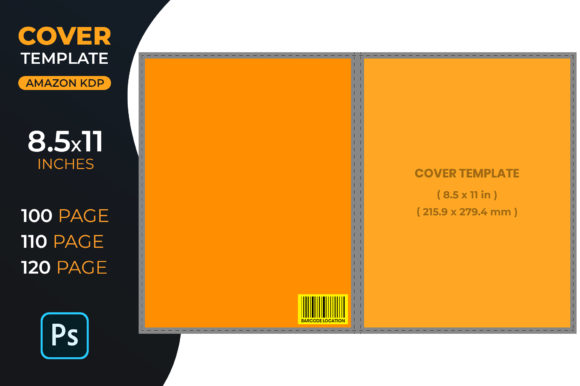
A book cover is a mini-poster, and the principles of visual hierarchy apply just as much to a 6x9 paperback as they do to a billboard. While the templates provide the dimensions (8.5x11) and the necessary 300 DPI resolution, they also guide how you should think about space. When you open one of the included PSD files, you are looking at a pre-calculated environment where the front cover, spine, and back cover are balanced.
Consider how this influences readability. If you place your title too close to the trim line, it risks being cut off during printing. These templates typically include guides that help you visualize the "safe zones." This allows you to focus on the creative aspect—choosing a serif font for a classic literary feel or a bold sans serif font for a contemporary non-fiction look—without worrying about technical compliance. The template acts as a stabilizer, ensuring that your typography choices remain legible and impactful once the book is physically in a reader's hands.
Furthermore, the inclusion of specific page count variations (100, 110, and 120 pages) is a practical detail that many overlook. The spine width changes depending on the page count and paper type. Using the wrong template results in a spine that is either too wide (causing the text to "wrap" around to the front) or too narrow (leaving the text hidden in the gutter). By using the correct PSD Cover Template for Amazon KDP, you ensure that the physical product matches your digital preview, maintaining the professionalism of your brand.
Strategic Applications for Entrepreneurs and Designers
For the entrepreneur or small business owner, these templates are a gateway to scalability. You are not just buying a file; you are buying speed. Instead of spending hours setting up guides, bleeds, and resolution settings for every new project, you can drop your artwork into the Smart Object and begin refining your design immediately. This is particularly useful for those in the low-content book niche—journals, planners, and notebooks—where volume is key.
For graphic designers and agencies, these assets serve as a reliable starting point for editorial design projects. You can pair the structural reliability of the template with high-end design assets. Imagine combining these covers with a script font for a wedding planner or a handwritten font for a personal memoir. The template handles the mundane technicalities, freeing you up to focus on the font pairing and color theory that will actually sell the book.
Choosing the Right Template for Your Project
When evaluating these templates, look beyond the visual preview. The value is in the file organization. A well-organized PSD file allows you to easily toggle layers on and off. This is crucial if you are designing a series of books and need to ensure consistency across different covers. You want to verify that the layers are named logically (e.g., "Spine Text," "Barcode Area," "Background Art") so that you or a team member can edit them later without confusion.
It is also worth noting the versatility of the 8.5x11 dimension. While often associated with standard letter size, in the context of KDP, this is a popular trim size for workbooks, educational guides, and coloring books. The templates are formatted to accept a wide range of creative font styles, from heavy display typefaces for fitness guides to delicate serif fonts for poetry collections.
Maximizing Your Investment
To get the most out of these files, treat them as part of a larger ecosystem. They are not just for one-off projects. If you are building a publishing business, you should view these templates as a permanent part of your toolkit. Keep your master files organized. When you create a cover you love, save the layered PSD separately from the flattened print-ready PDF. This ensures you can always go back and make edits if Amazon updates its requirements or if you want to refresh the cover design later.
Ultimately, the goal is to remove friction from the publishing process. By using PSD Cover Templates for Amazon KDP, you are prioritizing efficiency and quality. You are ensuring that your book meets industry standards while giving yourself the creative freedom to design a cover that truly represents your content. Whether you are a seasoned publisher or a first-time author, having a reliable, tested template is the first step toward a successful launch.